
Our Approach
TurningPoint delivers this strategy through community leadership, institutional engagement, and responsible use of accessible digital tools, including AI where appropriate. We strengthen existing systems and local capacity so inclusive practices continue beyond project cycles.
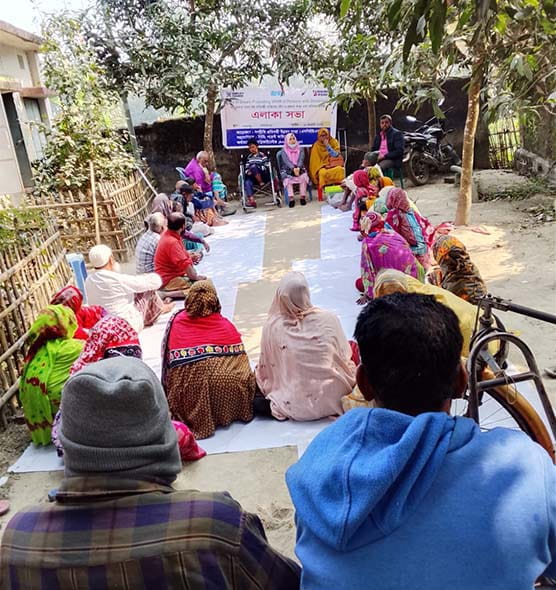
What guides implementation
We prioritise participation, accessibility, safeguarding, and ethical practice across all work. Digital tools support community leadership — they do not replace it.
- Led by lived experience: persons with disabilities shape priorities and delivery.
- Practical systems change: solutions that institutions can maintain with their own resources.
- Responsible technology: human review, privacy, and safeguarding are non-negotiable.
Implementation Approach
Our approach has five connected pillars — designed to support sustainable, locally owned, and accountable change.
01. Community Partnership and Local Delivery
We work with community-based organisations (CBOs) and organisations of persons with disabilities (OPDs) as core partners. Community members participate in planning, facilitation, and review to reflect local priorities and lived experience.
TurningPoint develops methods, training, and technical support; partner CBOs and OPDs lead local implementation and engagement with communities and institutions. Local facilitators are progressively supported to deliver activities independently.
02. Institutional Engagement and Systems Change
We engage service providers, local authorities, and other institutions to improve accessibility and participation in routine services and planning processes.
We support practical adoption through dialogue, joint activities, and workable guidance that institutions can maintain using their own resources.
03. Responsible Digital and AI Methods
Across all priorities, we use accessible digital methods — including AI where appropriate — to strengthen inclusion, participation, and efficiency (for example, faster content adaptation and follow-up).
Technology is used only where it:
- removes barriers,
- supports informed decision-making, or
- expands participation.
04. Learning, Adaptation, and Accountability
We use an adaptive approach informed by monitoring, feedback, and partner learning. Accessible feedback mechanisms enable community members and partners to raise concerns and provide suggestions safely.
Learning is documented and used to refine tools, methods, and partnerships during implementation.
05. Partnerships and Collaboration
We collaborate with civil society networks, government bodies, academic institutions, and private sector actors to strengthen technical quality, scale, and sustainability.
Partnerships are guided by inclusion, ethical practice, and shared responsibility for measurable results.
Safeguarding, Ethics, and Human Oversight
Human facilitation, safeguarding, and ethical oversight remain central to all interventions. Digital tools support — rather than replace — community leadership.
Clear boundaries for AI use
AI tools do not provide medical or diagnostic advice. They only support access to verified information and referral pathways.
All externally shared AI-generated content is reviewed and approved by trained staff or partners before dissemination.
Risk management and accountability
We recognise risks such as misinformation, bias, and inappropriate reliance on automated outputs.
Tools are used with human review, clear guidance, and safeguarding procedures so decisions affecting health, safety, or rights are never made solely by automated systems.

Work With Us
If you want practical, ethical, and inclusive approaches that can be sustained locally, we would welcome a conversation.
Need information in an accessible format? Contact us and we will support you.